
The Great Abyss
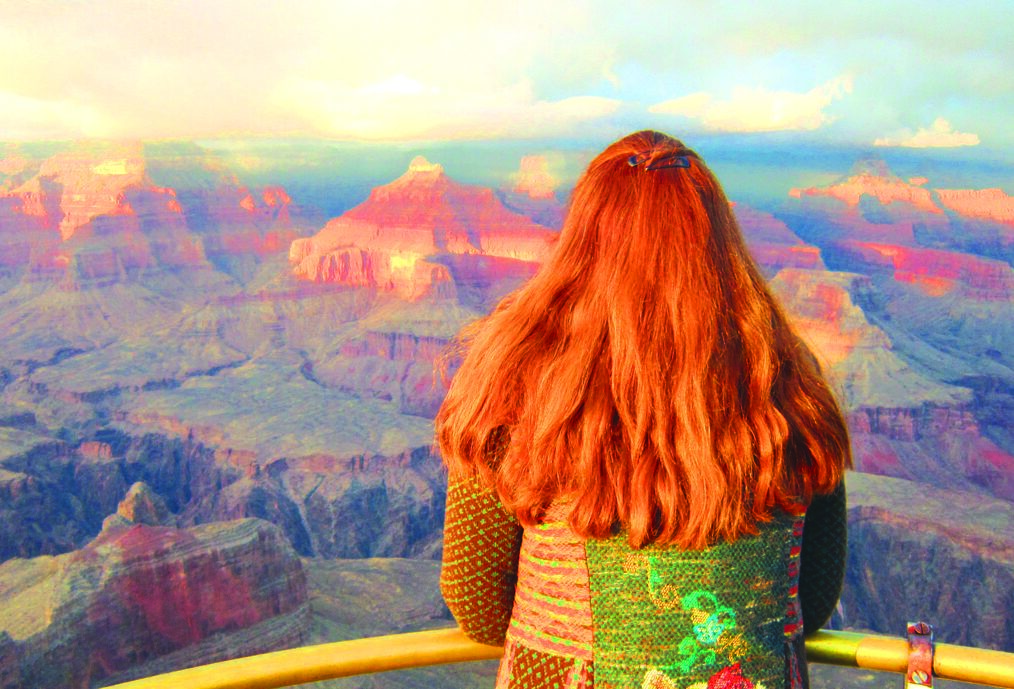
The shock is aggravated by the fact that you have no inkling whatsoever of its existence until fifteen feet from its edge. The first time you reach the rim of the Grand Canyon you will not forget. The sight simply astonishes; the array of walls and canyons, the hair of river far below, varying rays of sunlight as they play upon its shades, columns, and corners all fall away as far as the eye can see, reducing most to muted awe.
One pleasure of travel is reading about the place visited, and here, at the Great Abyss, I am well into Edward Dolnick’s Down the Great Unknown. The book chronicles the first running of the Colorado River by a one-armed, former Civil War officer named John Wesley Powell.
“Powell was face-to-face here with the great intellectual challenge posed by the seven hundred miles of canyon he had passed through and by the side canyons and caverns along the way,” Dolnick wrote. “The challenge was to accept the dizzying lesson the rock landscape proclaimed—in the immensity of time, water prevails over stone and shapes it as it pleases. To try to grasp the unfathomable stretches of time required for a trickling stream to carve a cathedral-sized cavern is to risk a kind of intellectual vertigo.”
Rim walkways are fenced where they come perilously close to the edge. The drop here is several thousand feet; we heard that someone drove off the cliffs earlier in the week. Where cities now experience “suicide by policeman," here, apparently, is "suicide by Thelma and Louise.” It is disconcerting to see people over the fences and straddling eternity, posing for photographs. Strolling along, I almost gasp as a cameraman films an individual perched on a crumble of rock twenty feet out and surrounded by air. A family watches dutifully; I approach and ask why the man is out on the ledge.
“That's our father," a girl tells me. "He's a minister from Atlanta; he's filming this Sunday's sermon.”
“The common belief among educated people was that God had created the earth a mere six thousand years before,” Dolnick wrote. “Then came geologists brandishing pickaxes and fossils and spouting theories that contradicted Genesis… The great, dizzying discovery of the nineteenth century was that time stretched backward farther than the human mind could grasp... The earth's age could not be measured in thousands of years, the geologists declared, but in millions, or tens of millions, or hundreds of millions. The notion left Victorians clutching their heads in bewilderment and dismay.”
Genesis, Exodus, Leviticus, Deuteronomy...
My family attended the United Church of Norwood. I was a choir boy and acolyte, and an early memory of Sunday School was of severe faces drilling us on the books of the Bible, Genesis, Exodus, Leviticus, Deuteronomy… how important to remember the books, in order, Genesis, Exodus, Leviticus, Deuteronomy... I recall my father's impatience with late arrivals and crying babies during the sermon, the unearthly voice of minister Leon Hatch who, in my earliest days, I thought was actually God, and finally my brothers’ Sunday morning routine of lying in bed absolutely still, my oldest admonishing any sound that might awaken our parents, waiting eagerly until the clock attained 9:45, too late to dress in time for the 10 o'clock services... Genesis, Exodus, Leviticus, Deuteronomy…
“The reason the view back in time proved so unsettling had to do not with the age of the earth itself but with what the idea of unbounded time implied about mankind's place in the scheme of creation,” I read. “The one point that both devout believers and hardheaded scientists agreed on was that humans were newcomers on earth. That was fine if the earth was young. But if the earth was ancient and man was the pinnacle of God's creation, why had He left the stage empty for so long?”
My mother's parents were born in the 1890s and possessed the last vestiges of Victorian manners. My grandmother was a child poet and historian, my grandfather a violinist in the Wellesley Orchestra. But they carried with them also ancient prejudices. When my teenaged mother came home with a Catholic boyfriend, her parents immediately pulled her from predominantly Irish-Catholic Norwood High School and enrolled her in predominantly Protestant Westwood High. When my mother first brought home my father, her first words through the door were, “This is Jack, he's Protestant!”
As a fourteen-year-old I was forbidden to play hockey on the local CYO hockey team. On St. Patrick’s Day my mother made sure I wore an orange shirt. But ancient prejudices, however slowly, eventually fade. My mother would live to see her three sons all marry Irish Catholic girls, and her only daughter marry a Jew.
“Powell found running rapids thrilling, but toppling outmoded doctrines was even better sport,” Dolnick wrote. “Truth, he insisted, was written in the rocks and not in the Bible... The Grand Canyon was a ‘library of the gods,’ in which ‘ten thousand dark, gloomy alcoves’ served as reading rooms. The shelves are not for books but form the stony leaves of one great book. He who would read the language of the universe may dig out letters here and there, and with them spell the words, and read, in a slow and imperfect way, the story of creation.”
Here overlooking the library of the gods, I marvel that two men can stand side by side yet be separated by such an abyss. "Nowhere on earth is God's handiwork as impressive and obvious as here at the Grand Canyon," the minister assured me, back from his perilous perch and waving out over our chasm. I nudge a rock at my feet. Stooping, I pick it up and show it to the man. I wish to communicate with the minister as clearly as he always has with me.
“It's my library card,” I say, and walk away.
More in this section
Mom Worries Daughter Making Bad Social Security Decision
October 1, 2026
Raking Mom’s Backyard
October 1, 2026
Ask Rusty – Must I Enroll In Medicare At Age 65?
September 24, 2026
Hackensack
September 24, 2026
Comments