
Town Meeting night 1 passes all articles, with some confusion
Closing session set for Nov. 19
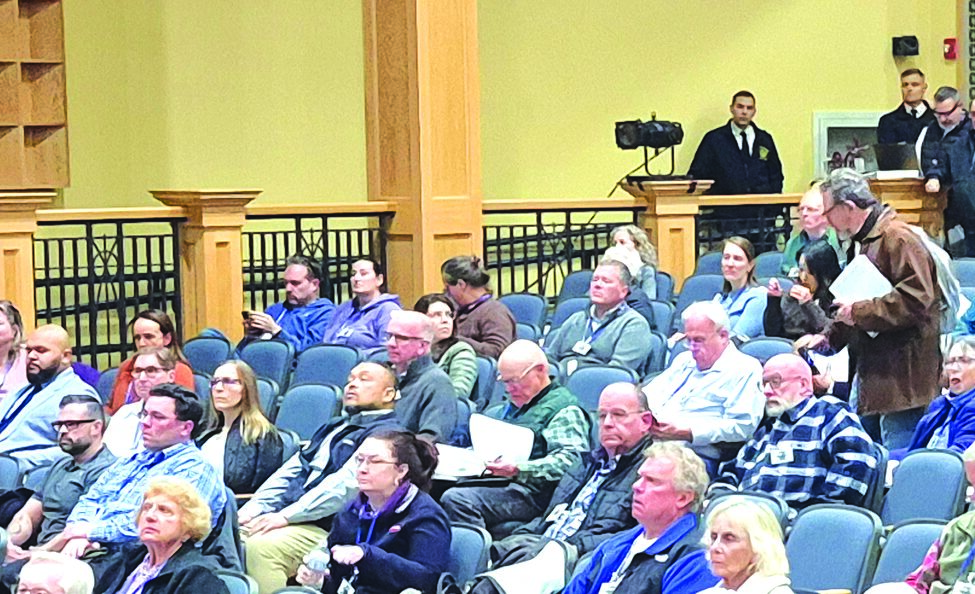
The first night of the Fall Special Town Meeting concluded with just a couple of articles left for this Thursday.
The issue with the biggest discussion was Special Town Meeting #2 Article 3, which dealt with taking out two density bonuses within the MBTA Communities Zoning Overlay District.
The district was part of former Gov. Charlie Baker’s farewell legislation, as it was one of the last things he did while in office. Basically, the idea was to force municipalities with certain MBTA infrastructure – or adjacent to it – to zone areas around said infrastructure for multi-family units, so as to increase the efficiency and usage of that infrastructure. Norwood rezoned enough land for a couple thousand units, and added density bonuses to help spur development in those areas.
Town Planner Sarah Dixon said the bonuses were designed to bring development that the Town actually wanted, in that it would encourage more open space and stormwater improvements – aka help to reduce flooding and the heat island effect.
This came from a citizen’s petition from May Town Meeting, and the Norwood Planning Board worked throughout the summer to make sure all i’s were dotted and t’s were crossed. If you change one part of the Zoning Bylaw, you have to change all references to it throughout the whole document, which is quite a task – it’s 212 pages long. Not to mention, making sure those changes are legal and checking them all through Town Counsel.
Dixon said both bonuses were found to be not needed, as the stormwater requirements in the bylaw were adopted for all development in the Town, and it didn’t make sense to offer to allow for more units and higher buildings for something a developer would have had to do anyway. The open space bonus had to do with allowing ground-floor parking underneath a building, and Dixon said that was nixed because it was found to discourage ground-floor retail.
The other bonus not nixed – at least for now – was that of an affordability subsidy. The affordability bonus requires an extra 5 percent of income-restricted units be added to the current 20 percent requirement and allows for a fifth floor and more units. Dixon said this was done because the state is currently experiencing a housing crisis.
Massachusetts has built less than half as much housing in the last 30 years as it did in the previous 30.
The other benefit to the Town was that at 25 percent affordability, the entirety of the building’s units count towards the Town’s affordable unit count, officially known as the Subsidized Housing Index (SHI).
The SHI hit the fan about 10 years ago when the Town was found to be out of compliance with Massachusetts General Law 40B, which requires 10 percent of housing stock or 1.5 percent of total land be dedicated to affordable housing, and the Town had less than 10 percent housing stock and was .03 percent off with its land total, allowing two developers to come in and ignore much of the Town’s Zoning Bylaw to build more affordable housing.
Residents fought that tooth and nail, to the point where the Town ended up buying the Forbes Mansion property and putting it in a $13 million hole that was only plugged because Moderna’s manufacturing hub came in and bought it, presumably because of the demand for the COVID-19 vaccine at the time.
So, Dixon said, helping to count all of a building’s units – including its market-rate units – towards the SHI would help prevent that from happening again.
Dixon said the Planning Board did not take that up, as it would require much more extensive review of the Bylaw than was available at the time. But she said they would continue to look at it.
Town Meeting member Ed Lynch said he wanted all bonuses removed from the Bylaw, but Town Moderator Gerri Slater pointed out that requires public meetings from the Planning Board, review of the Planning Board and Town Counsel, a comment period, and a notice period for Town Meeting to reconvene.
“The only thing you can do if you want to amend that motion is you can send it back to the Planning Board for study,” Slater said. “Unfortunately, with a Zoning Bylaw, there is a process you have to go through, which includes public hearings and to make sure there are no unintended consequences. So, if you do want to amend this motion, the only thing I can entertain is sending it back to the Planning Board for further study.”
“Okay, I’d like to do that,” Lynch said.
His motion was seconded, and it was written up.
Finance Commission Member Kelli Noumi commented she felt there was some confusion with the original motion.
“I hear a lot of, what I feel is misinformation or misunderstanding of what we’re voting on right now,” she said. “It’s said in this room that there’s a lot of disagreement about the density bonus, and that’s fair, but that’s not what’s on the table right now. Tabling this and sending this back to the Planning Board means the other two bonuses stay in place. It seems like people are really for eliminating these bonuses – I’m not advocating either way – but why are we deferring to the Planning Board to discuss it again when we can remove two now, and it has been indicated that the other bonus is going to the Planning Board for review?”
The amendment ended up failing, with 23 in favor, 112 opposed and 3 abstentions. Town Meeting is expected to wrap up Thursday night.
About the author
Jeff Sullivan Covers local news and community stories.
Comments