
Board of Selectmen iffy on residential exemption
Moving around the tax burden
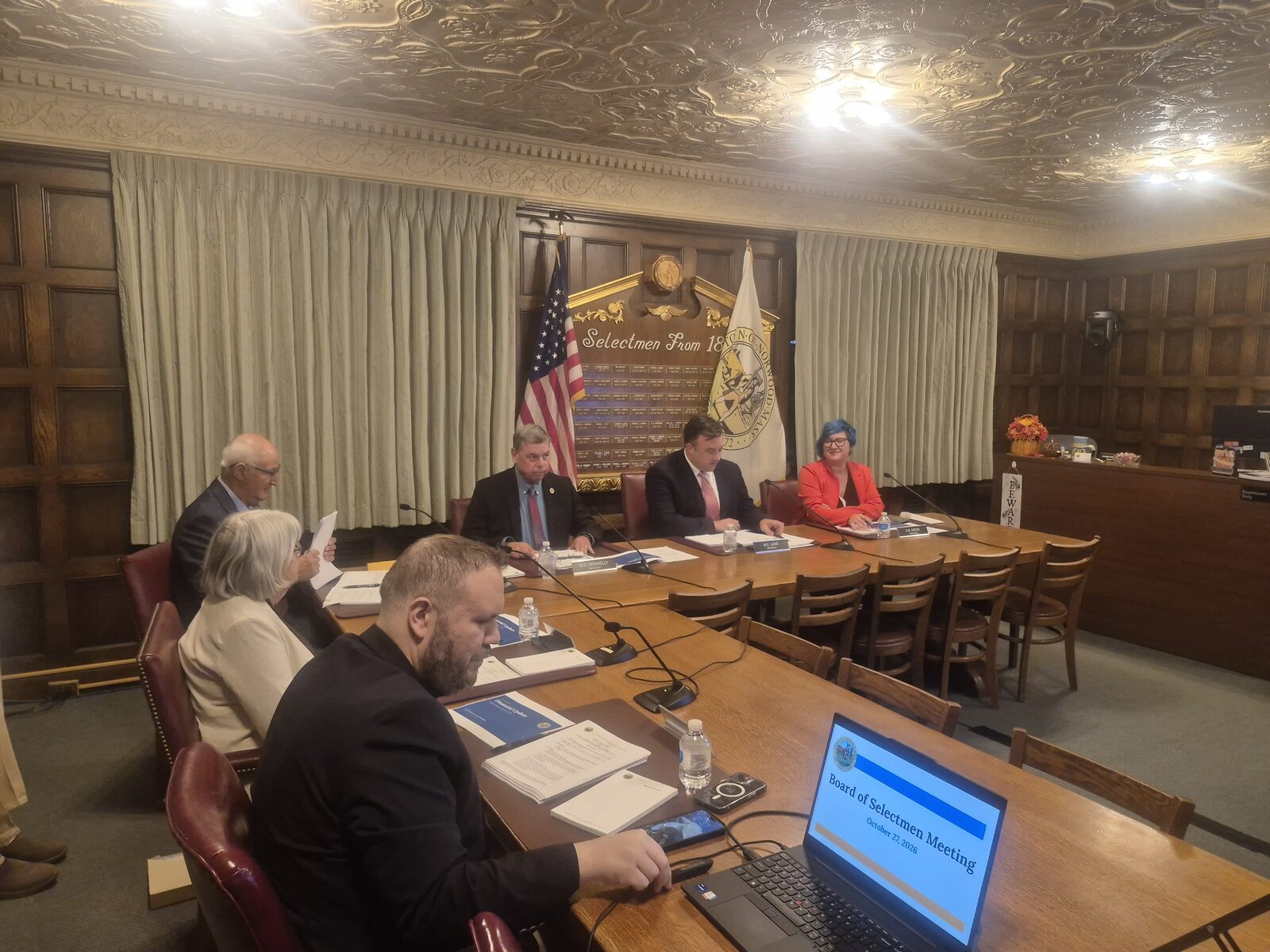
On Tuesday, the Norwood Board of Selectmen met for about an hour at the Harry Butters Chamber of the Norwood Town Hall with only a few appointments.
The biggest appointment was with Finance Director Jeff O’Neill and Principal Assessor Lee Keomanivong, who each came to the Board with different financial issues.
Keomanivong came with a study commissioned through citizen’s petition at Town Hall. The petition centered around looking at how a residential tax exemption might work in the Town of Norwood.
Several municipalities, Keomanivong explained, currently have residential exemptions that allow owner-occupied dwellings of a certain assessed value – that’s a key point here – to be assessed at what essentially would be a discount and have lower taxes. Keomanivong explained, however, that this comes at the cost of shifting the tax burden to higher assessed properties and rental complexes.
“We’re basically reducing the valuation of owner-occupied properties,” he said. “Unlike the other statutory exemptions, that is the only qualification.”
Keomanivong said the current maximum exemption is 35 percent, and only applies to owner-occupied residential properties; no commercial or industrial properties. He said if the Town enacted an exemption, which would be done through Town Meeting and Board of Selectmen approval, the Board would set the rate – between 0 and 35 percent – and knock the assessed value down by that percentage.
That is, if the property owner is aware, qualifies and applies for the program.
Keomanivong said the Town would then need to prove that the property is owner-occupied, which Town Manager Tony Mazzucco said could be an onerous task, depending on how many applications they would get for this exemption every year. And Keomanivong said he’d likely need a bit of extra staff, at least at the beginning, to process those applications.
“The first couple of years are different than ongoing,” Mazzucco said. “The first couple of years we’re probably going to need the equivalent of a full-timer to deal with, and it never completely goes away. And one of the reasons it would take a lot of time is that as properties transition every year, people put their homes into different kinds of trusts. If you don’t have your home in the right kind of trust, you may have to pay the higher right. And it gets complicated, so Town Counsel may have to take a look.”
Mazzucco said on average, he expects the cost to take another $50,000 a year in staff resources.
Keomanivong said 21 cities and towns in Massachusetts use this program.
“They have a certain makeup; Boston, Cambridge, Brookline, with a lot of apartment buildings and they are able to push the burden from owner-occupied buildings to apartment buildings,” he said. “And also Provincetown and Nantucket, where there are a lot of vacation homes and second homes, for which they were able to push the burden.”
Mazzucco wanted to point out here that all these communities that adopted this program either have pockets of or are defined by high concentrations of wealth or very, very dense.
“Though we probably wish we had Cambridge’s money or probably Wellfleet’s beaches, we unfortunately have neither,” he said.
The residential exemption would not really affect properties of larger assessed value – which usually means larger houses or properties – because the tax rate goes up as the assessed value goes up, reaching what Keomanivong called a “break even” point where the discount basically equals the increase. That’s how the tax burden would be shifted over to more expensive properties.
Keomanivong said Norwood is mostly owner-occupied – about 63 percent – and because of this and the shift discussed in the paragraph above, the burden would mostly fall on higher-value properties.
“The theory behind this is you want to shift the burden from one set of the base to the other; you’re kind of shifting it onto yourselves because of the makeup of Norwood,” he said. “I talked to one of the towns on the Cape, and they are 30 percent owner-occupied, whereas we are mostly owner-occupied.”
He and Mazzucco pointed out that increases to rental properties are typically passed on to the tenants, and showed a chart showing estimated rent increases if the exemption had been in place this year. Average annual rents on several different properties – estimated with several different exemption rates, 10 percent, 20 percent and 35 percent – showed annual rent increases going up anywhere from $142 to $1,305.
“I think it’s important to look at that average rent increase per unit,” said Mazzucco. “So take a typical triple-decker, the per unit costs would be going up about $100 a month at the higher exemption level. At the lower level sure maybe it’s $20 to $30, but that cost gets put onto them and higher-value single-family homes.”
Mazzucco stressed that the Town is not proposing to do this. He said back in May, studying this exemption was a vote of Town Meeting brought on by a citizen petition, and this analysis is the fulfillment of that vote.
The Board members appeared lukewarm, to say the least, on the idea.
About the author
Jeff Sullivan Covers local news and community stories.
More in this section
Trunk-or-Treat sees hundreds
Town Hall parking lot sees uptick in paranormal phenomena
October 29, 2026
Norwood Airport Commission votes on Airport hunting
More detailed procedures to be established
October 29, 2026
Comments