
Stonecutting demo coming to Old Parish
Old ways the best ways
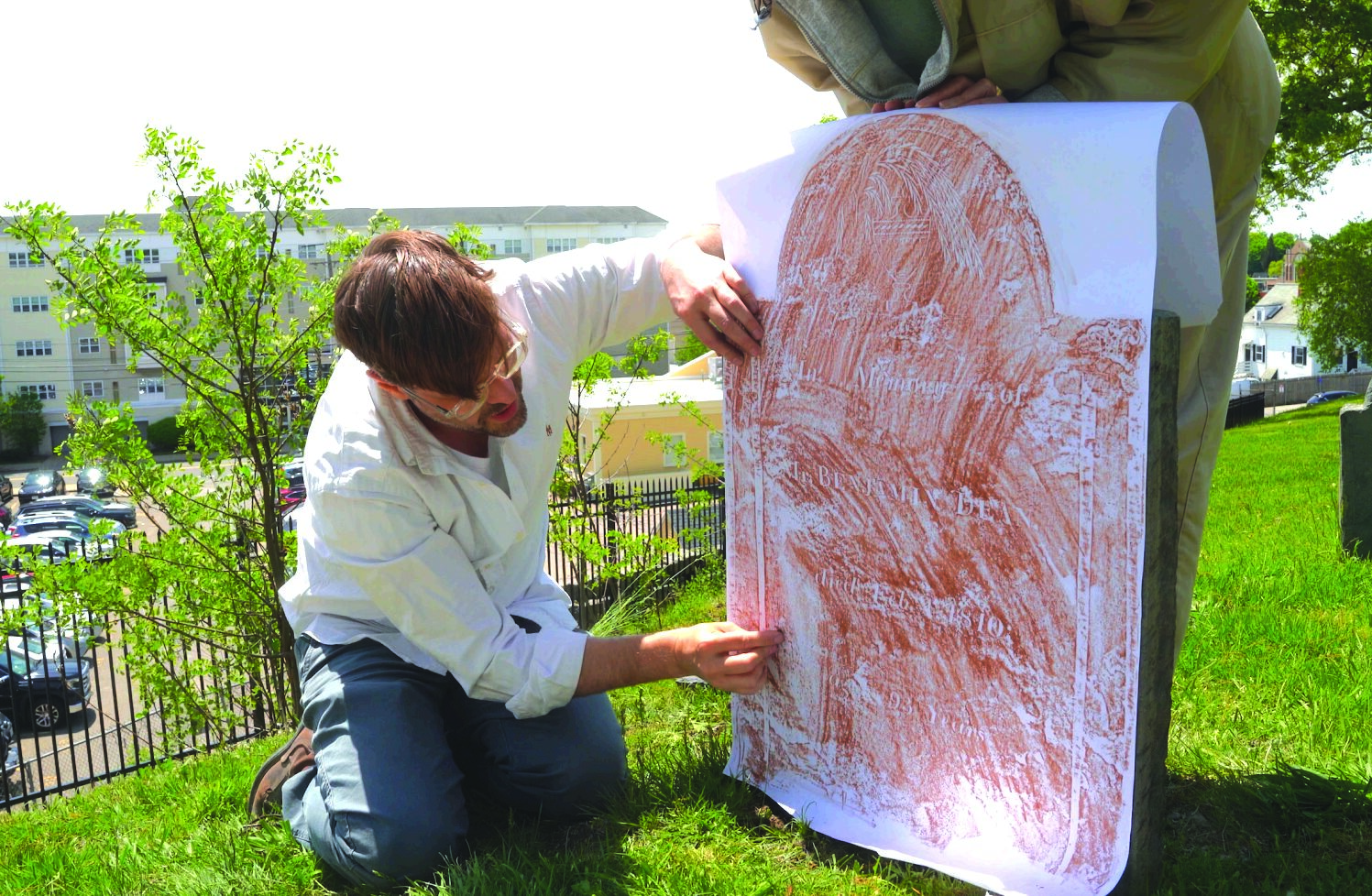
Stonecutter Andrew Carr will be coming to the Old Parish Cemetery on Oct. 10 at 2 p.m. to give an hour-long demonstration and talk about stonecutting by hand.
Carr said that this method of creating stone memorials goes back even to ancient times, and noted that recent archaeological digs found cutting tools very similar to his own, but these dated back thousands of years.
“They found these old chisels in a pharaoh’s tomb and they look just like the stuff I use today,” he said. “It’s amazing that it’s such a timeless kind of design.”
Carr was originally contacted by Norwood historian Patricia Fanning to come to Norwood to recreate the headstone of Mary Dean, who died in 1803. He said he had a “fragment” which was basically a one-eighth slab of the original headstone to work with. He said, however, that the stone was cut by a well-known stonecutter of the era.
“Thankfully, her husband’s headstone was fully intact and carved by the same stonecutter, allowing me to fill in the missing elements, such as letters and imagery for the tympanum border,” he said. “Both stones were carved by Cyrus Pratt, and you can find examples of his work throughout the cemetery.”
Just because he had a good guide, Carr said it’s not as easy as copy paste. He said he went out to the cemetery and took etchings of Benjamin Dean’s headstone, which had the same style as his wife’s headstone and many others throughout the cemetery. He said then, he took the etching home and started tracing it onto the slate stone, which is the material most of the graves used at that time.
“I want to make sure it’s as accurate to the original as possible,” he said. “This kind of layout takes a great deal of time to transfer, and everything is very painstakingly matched onto the stone.”
Carr said the tympanum, or lunette, is the top crescent of the headstone where a lot of decoration and maker’s marks reside. For the Dean family, he used a willow tree with a broken branch over an urn containing a pineapple.
Yes, that was a sentence. But each element had a specific meaning. The broken branch of the willow was Pratt’s logo, for example, and the pineapple was a symbol of wealth and prosperity. Some Victorian entrepreneurs even had loaning schemes for pineapples for up-and-coming families to rent for parties to show off – but crucially, not eat – their tropical wealth – https://gvimes.link/pnappl
He said it’s a progression of fashions throughout the colonial period.
“The first colonial gravestones had the iconic death’s head – the skull with wings – and that transitioned from the skull to a soul effigy, which was a little more friendly, gentle and a little less grim,” he said. “And then, for whatever reason, it transitioned from the effigy to the willow and urn in the late 1700s, and went all throughout the 1800s. It was very common, and then slate transitioned into marble, marble into granite – but these gravestones were carved in the early 1800s.”
Pratt said he’s one of just a few hand stonecutters left in the country, but he’s happy to carry on that tradition.
“Gravestones like this really started in the Boston area, and defined every future generation, and I want to be a part of that tradition,” he said. “I see very, very few people doing this today. It is a trade, an art form, a craft on life support. There are probably only 15 other stonecutters doing this in the country.”
Carr added that the hand-crafted nature of the memorials is something special, at least to him.
“I think there are a lot of memorials now that are quickly put together and I wonder if people are going to look at the majority of memorials that are created today,” he said. “When I see a marble headstone that is weathered and decayed, it’s just more special. Let’s say you look at a bouquet of flowers that is not as sharp as it was when it was first carved, but I would rather look at that decayed carving, rather than something that’s been sand blasted into granite. A carving in its decayed form, still says something. It says a lot.”
And when asked if he thought Mary Dean would appreciate the new stone come Judgment Day, Carr said he hoped she would.
“If her spirit is looking down, I think she would be very pleased with her community in the future preserving her memory,” he said. “I do think about these stones outliving me, which is odd when you’re setting them in the ground. You look at them and you’re like, ‘Oh, this is going to last a lot longer than I am.’ It makes you kind of aware of your own mortality.”
For more information on the event, go to https://gvimes.link/oldprshvlntrs
About the author
Jeff Sullivan Covers local news and community stories.
Comments