
Mechanical stacking a sticking issue
All TM articles pass, though with some friction
The Norwood Special Town Meeting (TM) met for its second night on Thursday, Nov. 19, at the Norwood High School to take care of its remaining business.
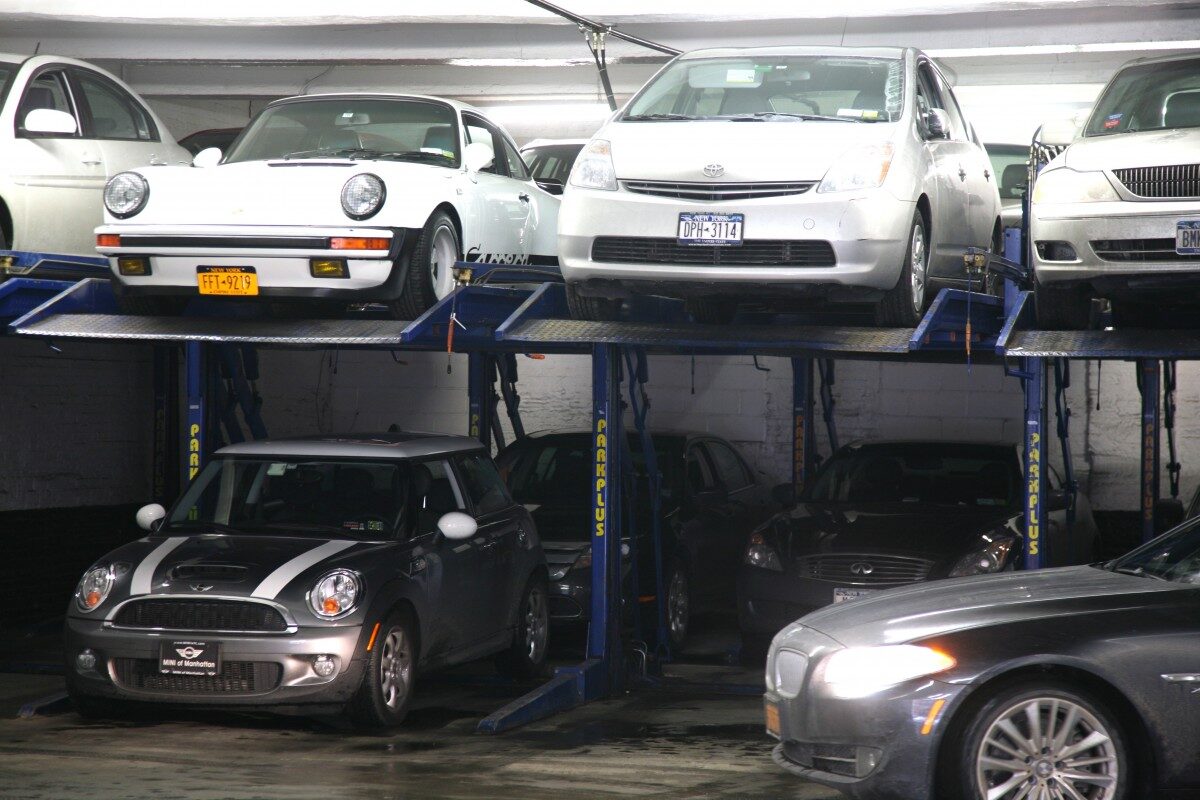
The issue of biggest discussion was that of parking definitions, specifically when it comes to stackers, which is when you use a mechanical lift to stack one car on another to increase the amount of available parking.
This all goes back to a proposed project at 55 Lenox St. that used stackers to satisfy parking requirements. The definition of stackers at the time appeared to fall under the tandem parking definitions, and, at the time, Town Counsel and the Building Department both agreed that the definition allowed stackers under the tandem parking definitions. The Planning Board, however, disagreed, and denied the project – https://gvimes.link/55lnxdnd
It’s still in a court case at the moment, as the owner of the project, John Shalbey, did not agree with the Planning Board’s assessment.
So, TM #2’s Articles 6, 7 and 8 all dealt with this issue, and under its original language basically outlaws all stackers in multi-family residences outside of the Boston Providence Hwy. District – which itself has only two areas for multi-family buildings in a mixed-use setting. Single-family residences are allowed to use stackers, so long as they are enclosed. Speaking of, all non-enclosed stackers – like you might see in New York City – are not allowed in any capacity.
There were several points of friction in getting this passed, in the form of amendments from TM members; however, they did not get enough votes to change any of the three articles.
The biggest point of friction was for Article 7, which set out the uses for stackers as explained earlier in this article, specifically in Footnote 16 of the proposed regulation – https://gvimes.link/bylwftnt16 – that laid those restrictions out. TM member Gerrit Betz said he felt taking away the discretion of the Planning Board to allow stackers to be used for multi-family developments to reach their parking requirements was wrong, and that it should be sent back to the Planning Board to have a more nuanced regulation written.
“Let’s imagine some hypothetical projects,” Betz said. “One project has a ton of mechanical parking in an apartment. Maybe the Planning Board doesn’t want to do that, even though it might be necessary to meet the minimum parking requirement. But imagine another project where they need 20 spaces, but there’s only enough footprint for 19, and they need to lift one space. The first line of Footnote 16 says you can’t do that. The Planning Board can’t consider that; they have no discretion, at least that’s how I read that, I could be wrong.”
Betz asked that it be sent back to the Planning Board and rewrite it to give the Board discretion within certain criteria, as he felt this was a blanket ban on mechanical parking. He said he hasn’t heard exactly why mechanical parking was wrong.
At the time of the 55 Lenox St. hearing process, several members said they did not want to allow it because the technology was prone to failure, citing examples. Then Associate Planning Board member Paul Eysie said, during Thursday’s TM, that he felt the stackers undermined the planning process of the MBTA Communities Act Process the Town had already gone through.
Explaining the MBTA Communities Act would be a whole other article, but basically, the state passed a law requiring land near MBTA commuter and fast transit infrastructure to allow more density. Eysie said they, more or less, got that density to 15 units an acre based on 1.5 parking spaces required per unit (height would probably also be a factor here). But Eysie said stackers would allow many, many more units than was previously proposed in the rezoning.
“When you go to a building and you think there’s going to be 68 units because that’s what Town Meeting agreed to based on parking, and you find out there’s 96 units being proposed? It’s wrong,” he said.
He used the example of 55 Lenox, pointing out that the proposed size of the building went up from 68 units to 96 units because of the use of stackers.
“He (Shalbey) filed some kind of engineering plan that said if you stack the cars on top of each other, you can have 97 (sic, 96) units,” he said. “If you don’t pass this tonight, we’re going to have other developers come through – and I’m not concerned with single-family homes if someone there wants to stack one car on top of another, that’s not going to impact us – but the multi-family apartment buildings going up in the Town? You’re going to give the developers a chance to come in and get more units if you allow the cars to be stacked.”
The amendment to send it back to the Planning Board failed with 45 in favor, 84 opposed, and three abstentions. The article itself, which outlawed stackers in multi-family buildings (save those on the Boston Providence Highway District), passed, but only after an amendment.
This amendment looked to change language in Footnote 16 “Mechanical Parking - Dual (Enclosed) shall be allowed by special permit from the Zoning Board of Appeals in any single-family residential structure, regardless of zoning district.” TM member and former Town Moderator David Hern said the word “shall” is an imperative, and implies that the ZBA would have to approve any such request.
Town Counsel David DeLuca, when asked, said that’s not the case; Hern disagreed, and said the language had to be changed, and Slater said DeLuca’s word was enough and it was not a danger.
Hern successfully appealed Slater’s decision, with the appeal vote coming in 68 in favor of the appeal, 62 opposed and four abstentions. The actual vote on the amendment to Article 7 came in at 93 in favor, 36 opposed and five abstentions.
Finally, Article 7 passed in a vote of 96 in favor, 35 opposed and one abstention.
Also during night two, during Article 6, which defined the terms, Hern had some issues with this, as he said the definition of tandem parking would only allow it by-right for residences in the single-family districts and the general residence district, making it a special permit request from the Planning Board for anywhere else. He said that seemed too restrictive and introduced an amendment to change it.
“There are residential properties in the General Business District (aka the Downtown), and other districts than S1, S2 and G (Single-Family 1, Single-Family 2 and General Residence)” he said. “In my view, tandem parking should be allowed without restriction in residential properties, at least up to four units.”
Hern said he wanted to amend the definitions to allow it for any residential property of four or fewer units. Town Moderator Gerri Slater, after conferring with Town Counsel, said she couldn’t allow that, as it would be too removed from the original motion, even as an amendment, and that it was the opinion of the Town Counsel that a new public hearing and feedback process was required through the Planning Board.
Hern issued a challenge to Slater’s decision to appeal the decision to the body, and send the amendment forward, arguing essentially that it was a small enough change to constitute an amendment, while Slater contended that, if the amendment was successful, it could lead to the Town being at odds with the State and have to basically do everything over again.
“Mr. Hern, what you are doing, essentially, is running the risk that these definitions and article will be rejected by the Attorney General’s Office because your amendment substantially differs and did not go through the public hearing process, which is required for a zoning article,” Slater said.
The appeal vote was verbal, but not enough TM members voted to put it in the article. There was a lot of discussion after this, as well as some discussion on whether or not to send Article 6 back to the Planning Board, but the vote went 96 in favor with 38 opposed and one abstention, constituting a 72 percent vote in favor – just eight votes over the two-thirds majority needed for zoning articles.
Article 8 had far fewer arguments, as it was mostly rewriting the rest of the Zoning Bylaw to reflect all the changes made in Articles 6 and 7.
About the author
Jeff Sullivan Covers local news and community stories.
More in this section
Trails talks Moderna donation
Health trail and unsanctioned crossings also on docket
November 26, 2026
Comments