
ZBA denies kennel appeal
House business in commercial district in the dog house
The Norwood Zoning Board of Appeals (ZBA) met last week and voted unanimously to deny an appeal from resident Marybeth Catalado’s business, The Lucky Leash Dog Walking and Pet Care Services, for what is technically a commercial kennel.
Cataldo said she had been operating the business for several years now, but was informed by the Building Inspector that she could not continue due to the fact that she had a commercial business running in a single-family home, which is not allowed. Building Inspector Gary Pelletier issued a cease and desist order, with which she complied.
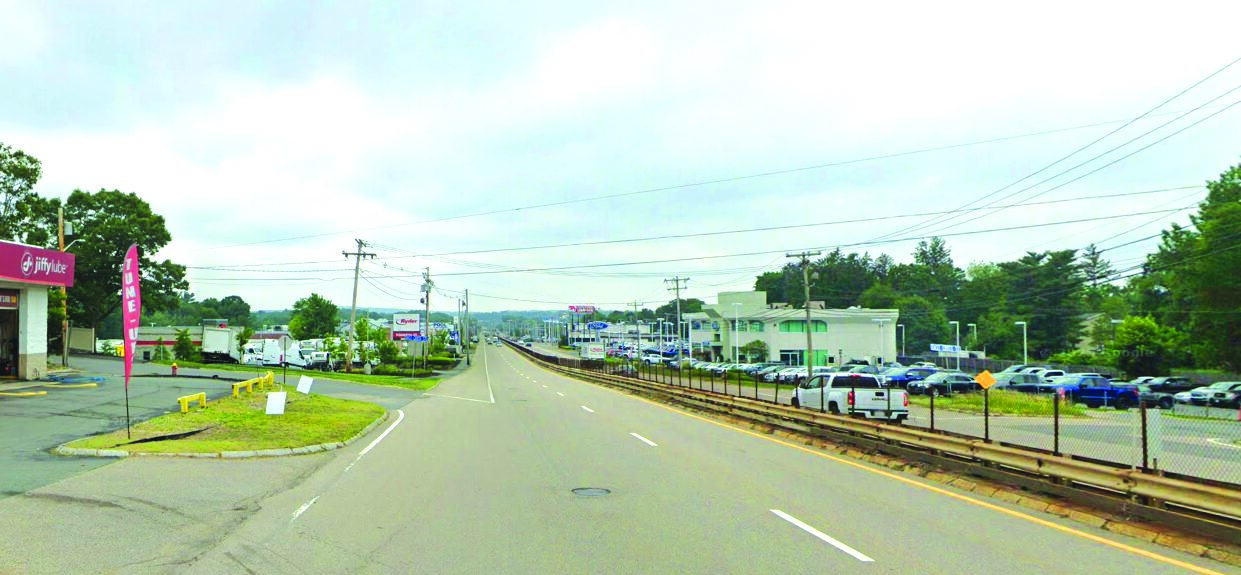
Caltaldo said she and her son have been running a pet day care service for several years now out of her home on East Cross Street. That’s kind of the rub here, as her home is technically in the Boston Providence Highway District – it sits close to the corner – and the pet day care use (classified technically as a kennel) would be allowed, if only it wasn’t in a residential home.
“That’s the only obstacle I have,” said ZBA member Paul Eysie. “There’s photographs, no complaints, I don’t see any police reports, nothing. Even though it’s zoned for highway business, it’s still in a residential neighborhood.”
“Yes, if the structure was changed and no one was residing in it, it seems like the use would be different, but because it is also a primary residence, I think this was the challenge the Building Inspector had.”
Cataldo said she has had a lot of support from neighbors while getting her application together. One resident became audibly emotional testifying on Cataldo’s behalf.
“My dog has epilepsy,” said resident Kalyn Rockman. “I get a little emotional about my dog. She has been very very kind to my family. Very genuine about caring for my dog, and I couldn’t let anyone care for my dog except for her. My dog is very ill. Thinking that this may not go through for her, it’s very disappointing, because I don’t know what to do with my dog. And it’s not just about me, it’s about her compassion for animals and people in general. It’s about helping people.”
The appeal to the ZBA was requested through the home occupation use, which includes uses like office, studio, or workroom. That kind of use request comes with several restrictions, one of which states that the noise level cannot exceed what is there for regular residential uses. Member Rachel Churchill said she feels by definition that would be the case, as Cataldo is seeking to have six dogs in her commercial business, whereas a residential personal kennel use (which is just someone who wants to own more than one or two dogs and not looking after anyone else’s dogs) allows for three.
“I’m having a problem with noise and effects not exceeding those of normal residential use,” Churchill said. “So from a numbers perspective, we know the normal residential use is three dogs, and we’re talking upwards of three times that (for a commercial kennel use) and with the history of the zoning bylaws really focusing on the number of dogs… I’m having a real hard time with that because obviously, more dogs are louder.
However, that’s not exactly how decibels work. Distance and power are factors in how sound shows up on a decibel counter, and sound increases flatten the higher the decibel count goes: https://gvimes.link/dbexplained
So more dogs means more noise, as one dog’s bark does not increase in volume in the presence of another dog’s bark. So not necessarily a louder noise. Regardless, Cataldo pointed out the area is already lousy with noise, because it’s near the business district of Route 1, the Boston Providence Highway District.
“I have recordings of ambient noise from our neighborhood,” she said. “This is not a quiet neighborhood, because of the variety of sounds coming from Route 1 and nearby commercial businesses.”
“Our street is the epicenter of many businesses and a major highway,” said Cataldo’s son Christopher, who helps out with the business.
“I am not offering that as a justification for excessive barking,” Marybeth Cataldo said. “We will not allow that. I’m simply providing context for the Board considering whether or not occasional barking or the sound of dogs playing would interfere with our neighbors’ enjoyment of their properties. Our property is somewhat unique. It’s located at the top of a hill at the edge of our neighborhood and adjacent to Route 1 and the surrounding businesses. It is surrounded by mature oak trees well back from the street and screened from neighboring properties.”
Cataldo said when she went around the neighborhood looking for letters of support, some of the best feedback was that several neighbors didn’t even know the dogs were or had ever been there.
Back at the deliberations of the ZBA, Churchill also pointed to the use table interpretation clause in the Norwood Zoning Bylaw – 3.1.4 – which stipulates that if you have two or more categories of uses being considered, you’ve got to classify it as the “more restrictive use.”
“If equally specific, the more restrictive category shall govern,” she said. “I think with this falling squarely in the use of commercial kennel, I think that kind of governs over the less specific home occupation.”
The discussion was lamentable, as many ZBA members appeared to sympathize with Catalado. The issue is almost a ‘chicken and egg’ argument. The ZBA only has the power to specifically lift Pelletier’s decision on whether the kennel can be classified under home occupation, which Churchill had pointed out with the interpretation rules in the Zoning Bylaw, she doesn’t feel the ZBA can.
Without the appeal, Cataldo can’t bring her business to the Planning Board to request a special permit. But the ZBA can’t put restrictions on her appeal.
“If we could limit this to three... I mean we don’t have the power to do that,” said Eysie..
“And if we were to grant the appeal, that’s something that would have to be taken up by the Planning Board,” member Shannon Greenwell said.
Greenwell, acting chair, asked “Do we have a motion at all this evening?”
The Board did not answer for a full 17 seconds, a silence broken by Greenwell herself reiterating the arguments and consequences. This possibly denotes the conflict Board members were feeling. A motion for denial was put forth a little later, and the Board unanimously voted in favor.
About the author
Jeff Sullivan Covers local news and community stories.
More in this section
Selectmen discuss MWRA money, Town Common rules and Fire hirings
September 17, 2026
Comments