
Thanksgiving Day in an umlauted forest
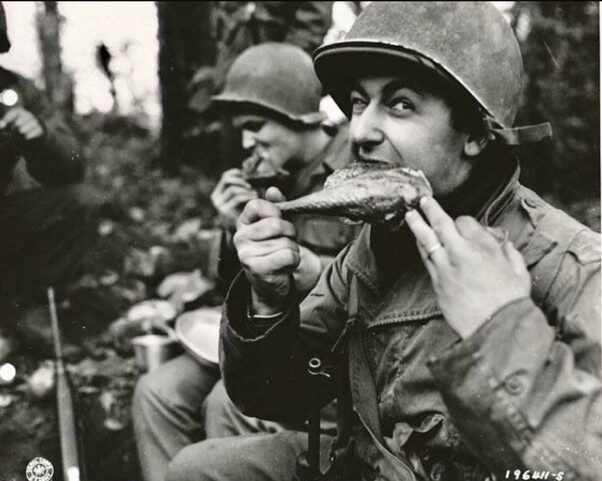
No matter what you have or don’t have to eat at Thanksgiving this year – because of the escalating food prices at our local Roche’s, Shaw’s, Stop & Shop, Lamberts’s, Trader Joe’s, Whole Foods, or Tony’s (Roslindale) Market – it’s hard to imagine it worse than as many American soldiers experienced in the Hurtgen Forest in 1944 (yeah, I know –there’s supposed to be an umlaut over the “Ü” in the forest name, but...). Located near the Belgium-Germany border, the “Green Hell’ was the site of 88 days of brutal carnage during the Thanksgiving Day season.
President Franklin D. Roosevelt in his Proclamation 2629 announced the official date of Thanksgiving for 1944 as November 23 and reminded our war-weary nation of reasons to continue to be thankful: “In this year of liberation, which has seen so many millions freed from tyrannical rule, it is fitting that we give thanks with special fervor to our Heavenly Father for the mercies we have received individually and as a nation and for the blessings He has restored, through the victories of our arms and those of our allies, to His children in other lands. For the preservation of our way of life from the threat of destruction; for the unity of spirit which has kept our Nation strong; for our abiding faith in freedom; and for the promise of an enduring peace, we should lift up our hearts in thanksgiving….”
Early as July 17, 1944, many months before Thanksgiving, the government began buying turkeys for the armed forces. The Army was trying to see to it that every soldier had turkey on Thanksgiving Day. The federal Farm War News column appearing in papers across the country relayed the news to the American public that though the turkey crop was excellent that year, the federal War Food Administration, which was responsible for the production and distribution of food to meet war and civilian needs, claimed that there were enough turkeys to meet only the military demand. (Turkeys were still under embargo for civilians, not yet available for them to purchase.)
The embargo was running later than the previous year because there were more in the Armed Forces and because, like most facilities, there was a labor shortage in the processing plants. Civilians were facing a similar shortage with another traditional Thanksgiving must – cranberries, many grown locally down near the Cape.
During the Battle of the Hürtgen Forest, American soldiers did receive a Thanksgiving meal despite the challenging conditions of war. This effort was valuable for maintaining morale among troops, as the war raged on year after year. Needless to say, the logistics were formidable, but soldiers did receive a hot turkey dinner, even as some cooks and bakers, unaccustomed to front-line action, were killed.
Lest we forget, in November of 1944 American families dreaded seeing military figures, frequently accompanied by chaplains, making their way to their homes. Telegrams, the major way of communicating, usually brought bad news. And of lesser import, there was no Macy’s Thanksgiving Day Parade in New York; it was canceled due to acute shortages of the helium and rubber needed for balloons. Moreover, there was no great enthusiasm for football games, and few Americans traveled to visit relatives given the strict rationing of gasoline.
Let’s give thanks this year that although America has other, tough problems to solve these days, none of these factors mentioned above characterizes Turkey Day of 2026.
More in this section
I Got An Overpayment Notice From Social Security; What Should I Do?
November 19, 2026
Unrenamed
November 19, 2026
Veterans’ Day
November 12, 2026
Change of mind
November 12, 2026
Comments