
Middle School transport an issue
School Com debates losing some stops
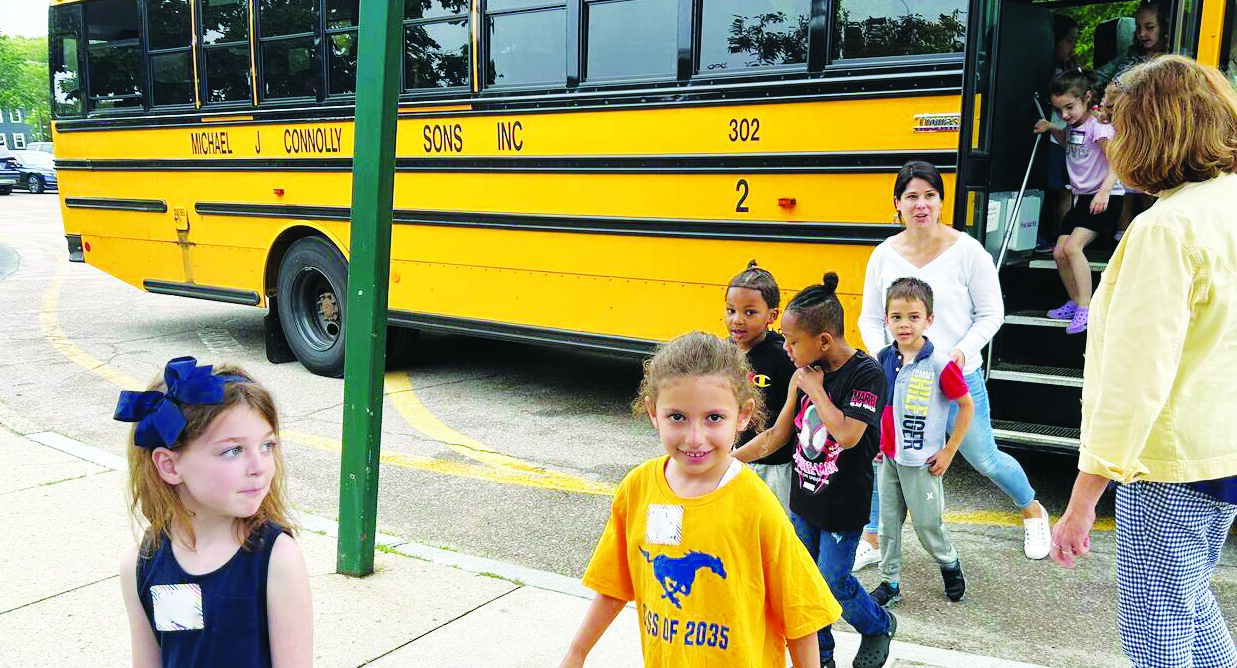
The Norwood School Committee (NSC) met recently and discussed issues around transportation and the budget.
The Committee has been going through all of its cost centers and fund generation ahead of this year’s budget cycle, ostensibly to show the department has been cost-conscious. The Town is looking to ask for an operational override for the Fiscal Year 28 (FY28) or FY29 years, depending on multiple factors, and the school and General Government administrations have been going through their budgets to trim anything they can before resorting to the operational override.
An operational override is when a municipality increases its tax levy over the 2.5 percent limit propped up by Prop 2.5 – https://tinyurl.com/m36ud95c – and the process to do so requires a successful vote at Town Meeting and in a Townwide ballot.
It should be noted that, aside from the specific transportation discussion listed here, Superintendent Timothy Luff did recommend a flat 2 percent fee increase on all user fees throughout the district to align with inflation. That includes transportation, athletics, fine arts, preschool tuition, building use fees, and Chromebook insurance.
In this instance, Assistant Superintendent of Finance and Operations Sean Mannion recommended cutting a few stops for the Middle School bus routes, as they are close to capacity. The state requires that any student living over two miles from their stop be picked up by the district without a fee (aside from the flat administration fee all bus riders pay) and if you live within that radius, you can ask for bus service but it’s not guaranteed and there is increased cost.
For the Coakley Middle School, Mannion said the department is recommending cutting several stops in South Norwood on the way to the school within one mile, as it is expected that students will be able to walk to school.
“The increase to 16 buses for regular buses has been wonderful this year: there is no crowding; but we have a lot of students in the middle school (buses) and there is a lot of crowding. We are recommending eliminating any stops to Coakley that are under a mile. There are a few stops in South Norwood coming up Washington Street. We’re accommodating it this year by changing out routes slightly to swoop in and grab people, but it’s not ideal; we don’t want to add any buses next year but the middle school buses are crowded and we really believe students under a mile can walk that distance.”
School Committee member Joan Giblin asked how many students this would affect, and Mannion said about 25-30.
“You picked a bad time of year to talk about kids walking to school for a mile,” Giblin said. “I think that’s too far for middle school kids, it’s too far for – you can shake your head at me all you want but I don’t know of anybody in this room who would walk a mile in 3 degree weather.”
“My kids have had no option,” said member Ann Marie Mazzola. “This has been the norm for quite some time, it just didn’t get enforced.”
“We’re doing whatever we can to not have to add any buses and it’s been a struggle this year,” Mannion said. “The middle school buses this year are at capacity.”
Mannion said at the elementary school level, there aren’t really any students who have to walk over a mile after the redistricting, and the limit is currently a mile due to safety concerns. But he said the department felt for middle school students it was acceptable.
Member Teresa Stewart said she felt, despite the financial pressures, providing this kind of transportation was essential to some students, even if it means adding another bus to the roster.
“I don’t support eliminating bus stops,” she said. “I don’t. I think in today’s world there are so many safety concerns we have to think about. I think that families would have a very hard time accepting this, which I would completely understand, and it would come back on the School Committee in a very bad way.”
Stewart alluded to a decision a few years ago in 2022 (that, to be fair, the committee made over five years worth of deliberations) to switch school start times to allow for a later start for the high school, as well as the location of the Coakley, and pushing back the start time for the Coakley.
“We have made decisions that I 100 percent still stand by over the past couple of years,” she said. “with the Coakley, where the Coakley was going to be – that was a huge discussion – and acknowledging that where that school was going to be, and we also had a lot of public forums and heard feedback about grade 5 going there, and making sure those kids could be bused, and the school start time changes – that I still stand 100 percent behind. We have that school start at a time where parents have said, ‘I can’t easily drive my kid to school anymore.’”
Giblin asked how much does each bus cost the district each year, since they’re contracted from a bus company. Mannion said $80,000 to $90,000. It was pointed out that the School Committee went into rebuilding the Coakley at its old location knowing it was on the edge of Town and would be an issue for transportation, since students would have to come in from all over. But Giblin pointed out this will cost at least $180,000 a year for the next 50 years because of the school’s location.
“That’s multi-millions of dollars over time,” Giblin said.
But Stewart said that, after all that start time debate, the location of the school and the moving of grade 5 to the Coakley, the removal of the bus stops could be too much.
“It’s not something I could support at all, and I think if we need to add another bus, we add another bus,” she said.
Mannion pointed out that the state’s only legal limit for busing, for any school age group, is over two miles.
“If we bused only to the legal limit, we would only need bus 199 students, if we only stuck to the legal limit, that would be fifth and sixth graders,” he said.
Stewart pointed out that it’s an appearance of favoritism, possibly, because high school buses have the space for students under a mile from school and that limit isn’t being enforced. It’s only because the middle school doesn’t have enough space and not a matter of policy or rules.
“I think that if we say we care about attendance, and I know we care, and being on time, then you can’t take buses away from people, because there are a lot of reasons kids need to take a bus and there are a lot of reasons that kids cannot safely, or because of their health, walk to school,” she said. “I’m really against this and I think it’s really irresponsible. And I think it’s not in alignment with the things we talk about.”
For more information on all the schools’ pickup policies, fees and other issues, go to https://tinyurl.com/smzc2djv
About the author
Jeff Sullivan Covers local news and community stories.
More in this section
Planning Board approves Tiny Pillars site plan
Chair invited by BOS to discuss bylaw articles
October 8, 2026
Norwood Housing Authority hosts farmers market, resource fair
Helps families with food and fun
October 8, 2026
ConCom preventing encroachment, weighing up fines and lanternflies
Guild Pond Feasibility Study Oct. 8
October 8, 2026
Comments