
Selectmen approve Town Meeting warrant, and capital list
Denies liquor license for Rincón Caribeño
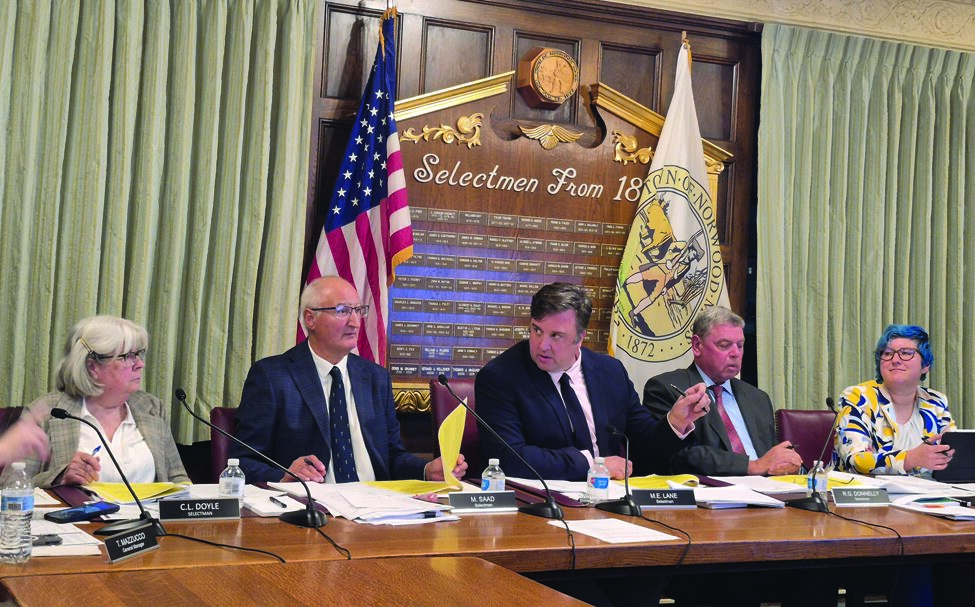
The Norwood Board of Selectmen met for about three hours on Tuesday for an appropriately packed agenda.
The Board voted 4-1, with Selectman Amanda Grow opposed, to deny one of the two available all-alcohol liquor licenses to Rincón Caribeño 2 at 111 Lenox St.
The proposal saw support from residents and business advocates from Hyde Park – the restaurant’s first location – including Hyde Park Main Streets Executive Director Thien Simpson. The Board also heaped praise on the restaurant, but cited its duty to be “good stewards” of the license (the word steward comes from the 1300s and means manager of a large household, who was usually in charge of the wine cellar).
This is an argument used in many past denials, but the idea is that the Board has to approve the license to a business that can get the highest and best use out of it. Basically, they need it to serve a lot of people. The restaurant was thought to be too small to do so, and with not enough parking.
Town Manager Tony Mazzucco put in that the location may be a biasing factor for the Board, as it is a strip mall with more parking than any big restaurant in the main Downtown Washington Street drag.
He also pointed out there is an annual cost to maintain the license, around $10,000 from the Town and the state, and Rincón manager Dawryn Pinales likely wouldn’t be applying for the license if he didn’t think the business would not be taking advantage of it.
Despite this, the Board still voted to deny, even while praising the restaurant itself. The location was just too small and, with around 24 seats, serves too few people.
Also, the Board approved Town Meeting and the spending for this year’s iteration of the Capital Improvement Plan (CIP) – which is also to go before Town Meeting. The plan contains about $2 million in free cash spending and several more in borrowing for large one-time spending items in the Town.
That’s not really out of place, but it has been slimmed down this year. The Town is facing a budget deficit of about $7 million (and has for the past three years) and is looking to keep as much free cash as possible to stave off an operational override vote until the FY28 or FY29 budget process.
So about $1.489 million was deferred in the capital plan to help with that, and another $1.9 million was moved from free cash as a funding source to borrowing. Mazzucco noted that several items – trucks, police cruisers etc. – have been moved over into a cycling cost in the operational budget. This was done because many of these items have foreseeable lifespans and were taking up a lot of capital budget that could be used for other projects.
The biggest conversation about the capital budget was that of the School Facilities Study, which readers may remember has been a sticking point for the School Committee and the Capital Outlay Committee – https://gvimes.link/schstdycoc
The study is looking at analyzing the elementary schools and the Savage Education Center for repair priority. The study has been postponed a couple of times now – originally it was part of a Schools request in Town Meeting – and also had its own Town Meeting warrant article, until that was withdrawn on Tuesday.
Norwood Public Schools (NPS) Superintendent Timothy Luff said the idea was to have two chances to get the study through. Selectman and Capital Outlay Committee (COC) Chair Bob Donnelly said he felt that was an inappropriate “second bite of the apple,” and Luff said the two requests came out of an unfamiliarity with the COC process.
All Capital requests were approved by the Board of Selectmen.
The only Town Meeting warrant article to be withdrawn was the school study, which brought the Special Town Meeting Warrant from six articles to five. Article 6 was unpaid bills – a functionary item almost always passed without contention – and it became Article 5.
All Town Meeting Warrant Articles, both regular business and the land use items, were approved. Article 1 was approved to be on the warrant, but it was a report so the Board took no action in supporting or opposing it.
Article 1 is a report from the Town Meting Rules Committee, and basically recommends tidying up Town Meeting language. The report will come this fall, and Town Meeting will likely vote on changes this spring.
Article 2 is a $708,578 appropriation from free cash to the Pension Reserve Fund.
Article 3 is a name change from the Norwood Board of Selectmen to the Norwood Select Board.
Article 4 is the capital spending plan, discussed earlier.
Artilce 5 is unpaid bills.
The Land Use Town Meeting Warrant was also approved, almost unanimously. The only contention came from Grow on Article 3, which is a moratorium on data centers. She said she felt the Board may be tripping itself up, as it may impact the Town’s own data center it runs for the Norwood Light Department.
She pointed out that data centers come in all shapes and sizes depending on their needs, and Mazzucco said it is very unlikely that Norwood would ever get a proposal for a data center like those seen causing disruptions and quality of life issues in Memphis or other large states.
The Board voted 4-1 to put the moratorium on the warrant.
The other articles have been discussed at length in The Record – https://gvimes.link/plnngtm2026
Articles 1 and 2 define and put in a table of uses for Urgent Care centers. Article 4 proposes to eliminate zoning incentive bonuses based on stormwater management/heat island effect and first-floor structured parking/open space. Town Planner Sarah Dixon said the stormwater bonuses are somewhat moot because since enacting the MBTA Communities Act Overlay District, the Town has enacted Stormwater regulations as strict as the bonuses all over Town, making the bonuses give more density for something already required anyway. The first-floor parking structure is looking to be nixed also, in this case, Dixon said, because it takes away ground-floor retail and community space opportunities.
Article 5 is parking waivers, which will go back to the purview of the Planning Board’s Special Permit process. The idea was that having a one-size-fits-none policy would lead to either too much or too little parking, and allowing the Board to vote on each proposal individually would be the better option.
Articles 6, 7 and 8 are parking definitions, and are related to stacked parking structures.
The Board also voted to approve new rules for the Town Common. Among the rules are bans on smoking on the Common, sleeping more than a half-hour, and restricts the use of the gazebo.
About the author
Jeff Sullivan Covers local news and community stories.
Comments