
Trails hosts field building talk
How to make it in the forests
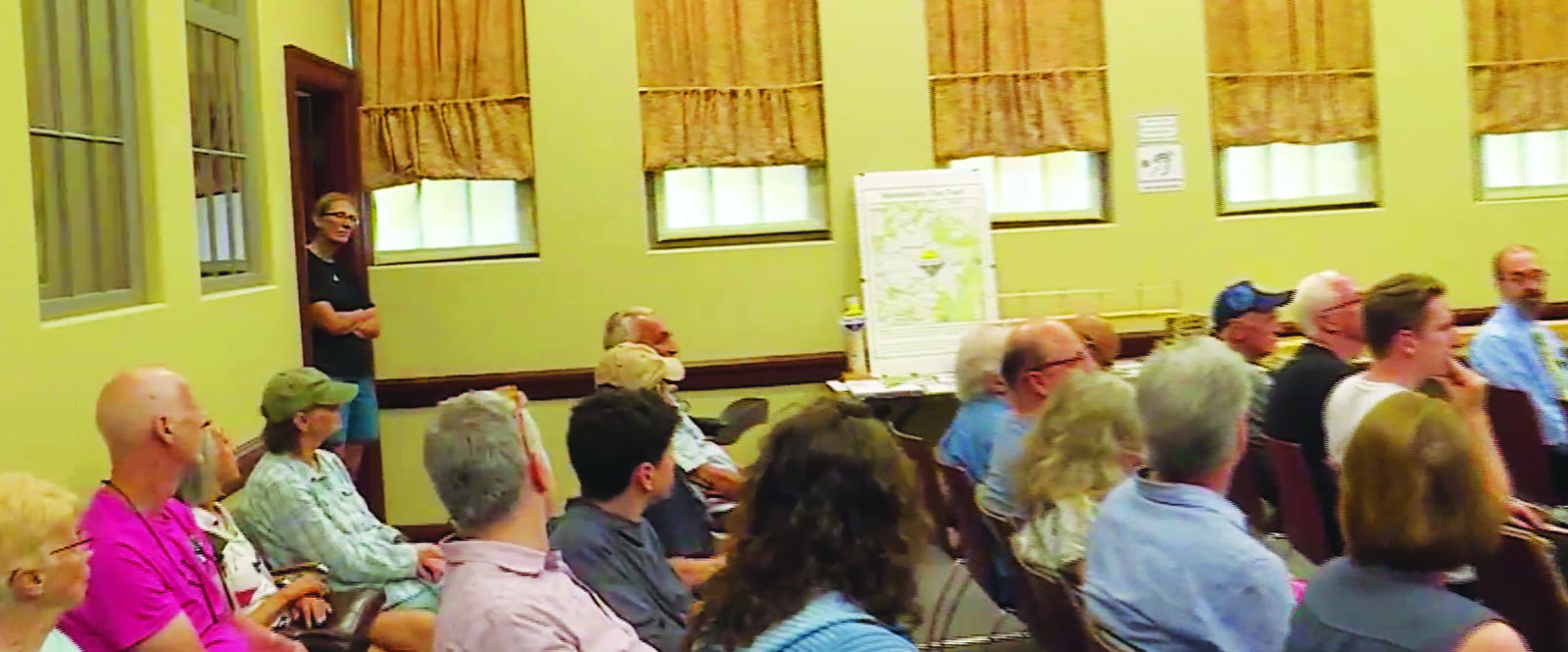
The Norwood Trails Advisory Committee (NTAC) held a special presentation to a packed room last Tuesday from one of its own members (and former Permanent Building Construction Committee member) Francis “Gerry” Hopcroft.
The talk was the culmination of a trail water crossing manual that Hopcroft and various other members of the NTAC have been working on for at least the past year. The idea was to take what the group had learned in constructing several water crossings in Norwood and combine it with techniques Hopcroft had learned working on such crossings in Maine’s Arcadia National Park.
The first thing to know is these are not bridges. According to Hopcroft, a bridge has a very specific definition and needs to be over a “navigable” waterway. He said the waterways they built on didn’t qualify.
“What we cross are drainage ditches, put in decades ago to try to drain the swamp,” he said. “That didn’t work out very well, but the ditches are still there. We’re putting our trails along the wetland and we’re going to cross those ditches where we have to.”
Much of the presentation was dedicated to technical details. Hopcroft pointed out that no 2x4 board is actually two inches wide and four inches long; literally they should be called one-and-a-half-inch-by-three-and-a-half-inch, but that’s a mouthful.
Hopcroft went over water crossing building techniques that essentially make construction in the forest feasible for residents without major construction equipment.
However, that doesn’t mean it was easy. Hopcroft related the construction story of three water crossings that were part of the Meadow Street trail system that needed a lot of ingenuity.
It should be noted that the team used up all its members’ ingenuity in the design, transportation and construction process.
“We have a whole team that comes up with creative names for our bridges,” he said. “The first one is called The Large Airport trench, it’s the biggest one we built. The second is called The Middle Airport Trench, and the last one, being the furthest North, is called The North Airport Trench. Creative? Maybe, maybe not. Doesn’t matter.”
Hopcroft said while they had decent construction methods hashed out for the structures themselves, getting the materials out there was a problem. For the nearest crossing, they carried the wood themselves. However, when the construction sites started going to over a mile away, it got more complicated.
“We got to the other ones, and realized this was not going to be a sustainable way to go,” he said.
So they tried using ATVs with trailers to get the wood out there, but he said that presented its own problems.
“That was interesting, trying to get 12-foot boards through the woods on the back of an ATV with two trailers that were not connected, except by the boards,” he said. “Which was way easier than carrying. Slower. But way easier.”
On the next crossing, they noticed they were very close to a boat launch on the other side of the Neponset River, which is managed by the Trustees of Signal Hill.
“Signal Hill has two canoe launch areas, which conveniently lie right across our trench lines,” he said. “So after a lot of discussion, they gave us permission to drive everything in along their roads, dump it on their sites, put it in canoes and rowed it across. We went to the next one, a little farther away, the team actually bundled all the lumber into a big raft, tied it together, put a canoe on both sides and paddled it over there.”
Another big issue they dealt with was weather. The second watercrossing the team did was earlier in the winter of 2025-26, and Hopcroft said they had the site prepped and the materials ready to go.
“But then it snowed,” he said. “And it froze. But we were undaunted by little things like that, what’s a bit of cold, ice and snow?”
So he said they had to lay sandbags around their construction site to build a coffer dam and drain it and allow for the water crossing’s footings to go into the ground. First problem, they had to cut the ice out. Second problem, they didn’t have enough sand bags.
“We were five short when we got out there,” he said. “No matter how fast we bailed, we couldn’t keep it from coming over the top. So we had to go out and get more sandbags. By the time we got more sandbags, it was frozen again. It was like six inches of water when we were cutting it with a chainsaw. Nevertheless, the old guys persevered.”
So the main takeaway here, at least appears to be, is to always be adaptable. Start out with a solid plan, but do not be afraid to deviate when a better option presents itself.
Hopcroft said they have four more water crossings approved by the Norwood Board of Selectmen, with four more in permitting.
“That’s where we are, and I’m looking for questions or volunteers,” Hopcroft said at the end of his presentation. “In any order.”
About the author
Jeff Sullivan Covers local news and community stories.
Comments