
Norwood’s Minuteman: Aaron Guild
Lexington and Concord remembered
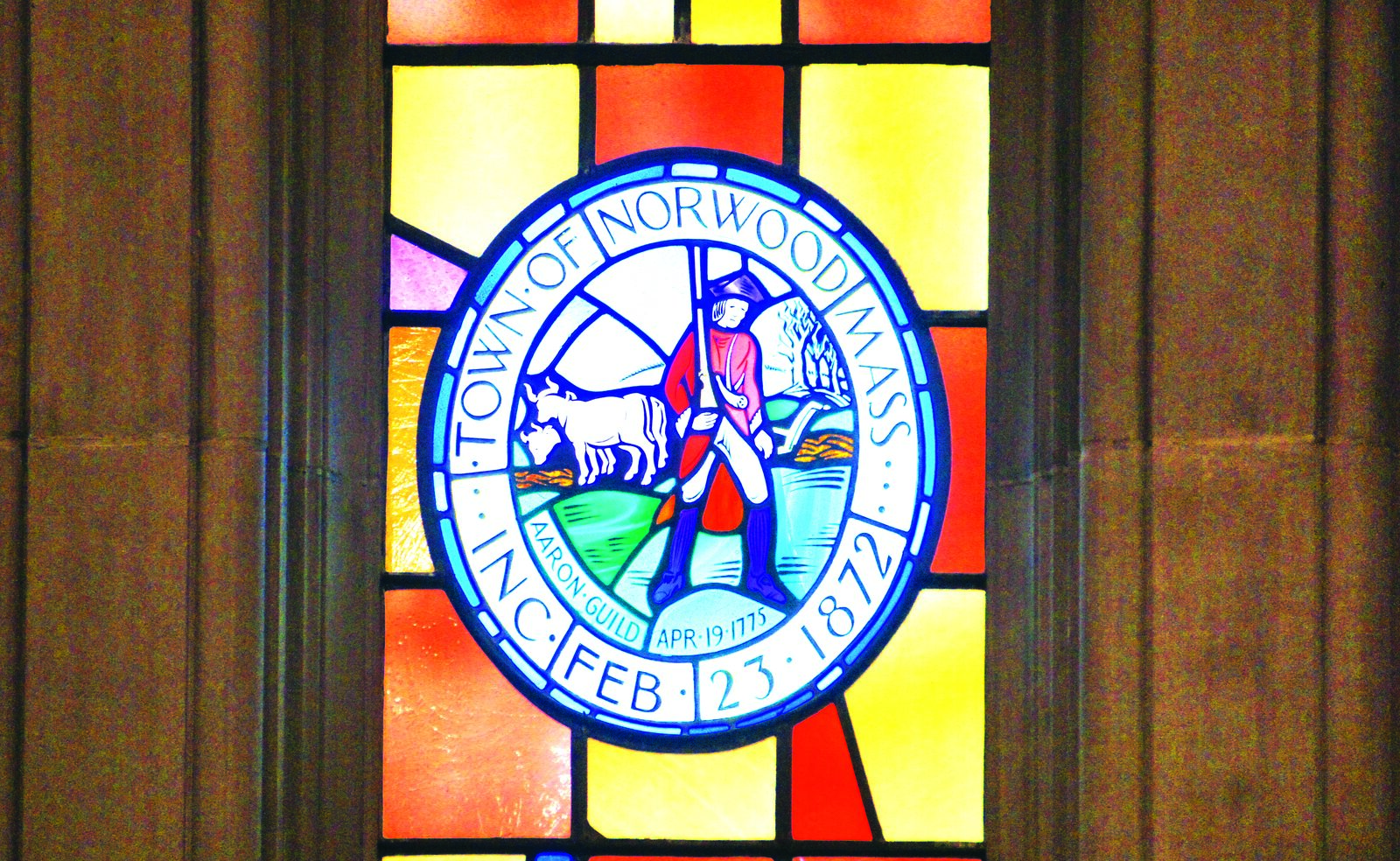
April 19, 1775 is a date many Americans recognize. It is the day nearly 4,000 men from communities across Massachusetts dropped everything to respond to the “Lexington Alarm” and fight the British Regulars. One of those men was Major Aaron Guild, a well-known figure in Norwood who is depicted on the Town’s seal with his musket and oxen.
A messenger rode through South Dedham (present-day Norwood) spreading news that the war had begun. It is said that Guild left his plow and oxen in the field, rushed to his home to grab his musket, and quickly departed to take up arms. He, several members of his family and several other South Dedham residents, took part in the attack on British troops as they retreated to Boston, likely joining the battle in present-day Arlington or Cambridge.
The Battles of Lexington and Concord, fought on April 19, 1775, marked the first major military clashes between the British Army and Minutemen from the Thirteen Colonies during the American Revolutionary War. The infamous “shot heard round the world” in Concord marked the start of the war (though some historians say the first shots were actually fired in Lexington). The British began marching back to Boston around noon, but were outnumbered by the Minutemen who joined the fight. Combat spread over more than 15 miles along the road from Concord to Boston. The skirmishes fought on that day resulted in 273 British casualties and 95 colonial casualties.
Born in 1728 in present-day Norwood, Guild was a fourth-generation descendant of Dedham proprietor John Guild. As a young man, Guild became a farmer on his homestead along Wrentham Road (modern-day Walpole Street). During the French and Indian War, he was a foot soldier and served under Captain Eliphalet Fales, taking part in the Lake George expedition. Guild was promoted to Captain in 1771.
During the Revolutionary War, Guild served as a Captain in the Massachusetts militia, commanding roughly 40-100 men (Source: https://gvimes.link/guildservice ). According to Old Parish Preservation Volunteers, he was stationed at Dorchester Heights for several days in March 1776, and then guarded Hull Harbor for four months with his company. Guild played an active civic role during the war, working on committees responsible for safety, communication, and family support, and was named Muster Master in 1775. He was later promoted to Major in the late 1770s.
After the war, Guild returned to his farm. He had 10 children: Aaron Jr., Oliver, Sarah, Jacob, Anna, Joel, Abner, Priscilla, John, and Nathaniel. Guild married three times – first to Sarah Coney, who died at the age of 21, then to her aunt, Annah Coney, and later to Sarah Blackman. While Aaron fought in the French and Indian War, Annah managed the farm and raised multiple children. Sadly, Annah passed away in 1776. Guild later married Sarah Blackman, and they lived together into old age.
Aaron Guild died at the age of 89 in Norwood, and is buried in the Old Parish Cemetery on Washington Street. His legacy lives on throughout the Town of Norwood. In 1903, a memorial stone was dedicated to Guild.
Located outside of the Morrill Memorial Library, the inscription reads: “NEAR THIS SPOT CAPT. AARON GUILD ON APRIL 19, 1775 LEFT PLOW IN FURROW, OXEN STANDING AND DEPARTING FOR LEXINGTON ARRIVED IN TIME TO FIRE UPON THE RETREATING BRITISH.”
The stained glass windows inside Town Hall depict Guild and his oxen. Guild Square on Walpole Street was once farmland owned by Aaron and his brother Moses.
Howard and Herbert Plimpton were the great-great-grandsons of Aaron Guild. They are known for inventing several bookmaking machines and opening the Plimpton Press facility in Norwood in 1897.
A 1943 Boston Sunday Post article telling the history of Norwood opens with: “The spirit that in ancient days inspired another to leave his plow to become Emperor of Rome was the same that urged Captain Aaron Guild of Norwood to rush from an unfinished furrow to join the Minutemen of Lexington. The little village that was hardly more than an apple orchard, a few farms, a store, and a post office, was as patriotic as any of those early settlements.”
Guild’s story, passed down through generations in Norwood, is one of a civilian who became a patriot in a moment of bravery. His legacy is connected to places around Norwood, making this history feel less distant and more “real”. Guild’s actions show that history was not only shaped by famous leaders, but by brave, ordinary people who took part in community-based resistance.
Guild’s descendants, now living abroad, came back to Norwood last year during the 250th anniversary of the Battle of Lexington and Concord. To read more, go to https://gvimes.link/guildfamily
More in this section
Planning Board approves Tiny Pillars site plan
Chair invited by BOS to discuss bylaw articles
October 8, 2026
Norwood Housing Authority hosts farmers market, resource fair
Helps families with food and fun
October 8, 2026
ConCom preventing encroachment, weighing up fines and lanternflies
Guild Pond Feasibility Study Oct. 8
October 8, 2026
Comments